

Fixing / Repairing a Joist or Beam End
By Andy the stuff doer
The first structural repair we had to sort out in our Whitby cottage was a couple of ceiling beams / floor joists. The ends had rotted away where they sit in the wall. The damp that caused the rot has been temporarily fixed (see the pan tile roof repairs article), a more permenant fix of a total re-roof is in hand.
The damage however had already occurred due to poor maintenance in the past. So a fix for the rotten beam / joist ends was needed. I did a quick evaluation of the more common techniques used to fix joist ends. However I came up with a different way of fixing the joists that is easier for me and more suitable for our particular problem.
I have made a comparison of the more common fixes for beam ends over on the main iDoStuff site.
The repair technique for rotten joist ends that I came up with is detailed with photographs also on the main site
If you find this information useful or interesting please let me know by leaving a comment below. Questions or even criticisms are also welcome. Thanks.
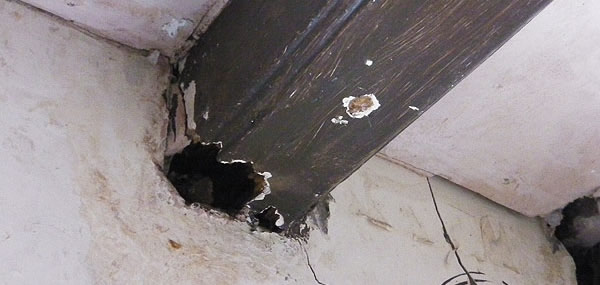
One of the two rotten joists
Crack in roofs and beam ends is one of the biggest problems these days. It disturbs the whole outlook of house. To make your house look beautiful and damage free, you have to opt for repairing process. The blog explains the repairing process quite interestingly. To know more about roof repairing, read more here.
Thanks for looking and leaving a comment. It’s great to see the blog gets noticed “over the pond”. We will be welcoming guests to our holiday cattage from anywhere in the world when it’s finished. You’ll be hard pressed to find a more atmospheric place to stay in the historic port of Whitby. It’ll be a must for any European tour. And rest assured the roof will have been properly fixed by then.
PS. I’ve left your link up but as you did spend some time making the comment relevent. Please don’t over do it though.
Cheers
Andy
“M” sent this comment by email, I need a bigger comment button:
Your site is most interesting, although for a time-pushed browser I got
a little lost within it, but I’m not really ‘having a go’, just got a
little lost trying to make a comment so backed out and emailed you
instead – hope that’s okay.
Your beam end repair was very interesting, and as a ‘sort of’ engineer
my view is that (I think) it works much, much better than something like
Bower Beams (which while from cold-rolled steel – excellent in many
respects versus hot rolled such as bedstead angle but somehow ugly and
not very ‘in keeping’) which always seemed to me to be a rather crappy
way of repairing a joist in a (most likely ?) listed ? property. It
wasn’t clear from your report whether the main reaction to the end
bearing force is counteracted by a bolt through (i.e. top to bottom) the
height of the joist, but I’m thinking that this must be how you did it
(the screws as a washer bearing is a fantastic tip – thanks !). A
conservation officer might baulk at the amount of ‘good’ wood removed
for the vertical slot to take the upright leg or the inverted ‘T’ – is
the cottage listed and was a conservation officer consulted ??!!!
Professionally of course I’d have to recommend getting the local
authority involved, but, off the record, ************* – with the view that their ‘leave it alone’ treatise is fine if you want to ‘play re-enactors’ or something (i.e. ‘it’s a house
for a sealed knot fanatic’) but when you live with 21st Century kit
(couldn’t live without the internet and my better half couldn’t live
without central heating and a big telly !!) you do end up having to
compromise and make the best of what you’ve got in the most respectful
way possible. Often the conservators seem to be at odds with this and,
amazingly, conservation trumps even the new religion of ‘the
environment’. In terms of regulations. But I digress.
I really liked the tile clip from a squashed piece of copper pipe too.
I’ve used pieces of copper pipe for many things in the past (levelling
woodburner feet on a stone hearth comes to mind) having spent much of my
life ‘doing up’ various old places. Seems a shame that plastic pipe and
push fit seems to have taken over, but, I’ll never ‘cut and shut’ small
sections of copper pipe through floor joists again (thankfully). I’ve
even got a few push fits on show here – in the past I always did the
exposed bit in copper – the Hep2o slimline fittings were great – sadly
now changed to a fitting thats almost as bulky and ugly as a JG Speedfit
(am I a bit sad going on about specific plumbing fittings ?)
The listing thing is quite funny really – I grew up in an old chapel
that had been converted to a house. For some reason that I’ll never
know, a buttress was taken down from one corner of the house and my
father then rebuilt it against the opposite corner. Nicely built, with a
fair amount of concrete fill internally, as was the way ‘back then’. The
property has since become listed and the listing mentions the buttress,
slightly suggesting I seem to think that it’s not original……. but so
little in a building is. Part of their charm is the bodges and fixes
that well-meaning handy-people have effected over the years. Somehow
conservators want to ‘freeze’ this, which I find strange, although we
are more ‘vicious’ in our renovations now (just like the Victorians
actually).
Finally, my question…. do you know of a supplier of epoxy resin for
beam repair ? I’ve used Isopon (from Halfords) in the past. The chopped
fibre glass stuff is great, over Ronseal wood hardner. But, wondered if
you knew of a proprietary resin repair system that a DIYer can buy,
since my search tends to just throw up companies that do the repairs
themselves. Which is all well and good, but, we seem (for our sins) to
‘enjoy’ doing this kind of thing ourselves….. (it must be the
hallucinatory effect of all those solvents over the years – or
ergotamine in the wood work or something).
Hope all continues to go well with your cottage renovation (I’ve done
quite a few now and when the lenders start lending again I’ll no doubt
do another….)
Hi M,
Thanks for spending the time to email, you’ve got some interesting comments
to make. If you don’t mind I post it on the blog for you.
I’ll have to look at the commenting on the Blog to see if I can make it a
bit easier to find and use.
I came up with the way of fixing the beam ends to be as discreet as possible
and to keep the corner profiles. So yes much better than the Bower Beams.
The alternative might have been a timber scarf but as well as being harder
to fitt it would have meant removing even more of the original timber. Yes,
you spotted the bolt takes the main reaction force all the way throughfrom
the bottom to the top of the beam (around 140mm). Glad to see you picked up
on tip with the screws under the washer.
The building isn’t listed so no C.O. involvment. That might change when
we’ve finished everything we want to do. The though of having to get
approval for everything including removing all the last 60 years worth of
bodges and cover ups would drive me mad. Having said that I don’t think any
C.O. will have major problems with the results. e.g. Last weekend I spent
breaking off the cement render from 3 walls to be replaced with lime.
Building Control is another subject we may have to cover at some point. In
the mean time work continues, doing things well, that will last,
significatly improve / maintain the building, improve energy efficiency all
with an eye to keeping as much as possible of the buildings character.
Plans keep on changing (see a post from Wendy about the shower – in a bit
when I’ve put it up)
The copper clips are a neat and cheap little fix, all it takes it a bit of
thinking about to save a shilling or two. They held the roof together and
helped to keep the rain out for a few months now. Next month were getting a
new roof laid properly this time with all the detailing in lead, a dear do
but it’ll last my lifetime.
I always use copper for the plumbing, I know it will last. I have my doubts
that the plastic fittings will stand the test of time. As all my proporties
are for “keeps” I only want to do the jobs once. I might be Ludite on this
one but for the sake of few pounds extra and some time, I’ll not take the
risk.
Timber repairs with resin is’nt something I’ve had to tackle yet although
I’ve researched it a bit on the net. But Ive used plenty of hardener and
epoxy filler, I’m in the middle of putting an article together on window
repairs.
You can get the resin, hardeners, fillers and mat direct from various
suppliers. I’ve bought resin ect. by the 5l in the past for regualar glass
fibre work. You might want to have a look at
http://www.wykamol.com/services/timber-treatment/timber-repair-products.html
And a search for “Timber Grout” throws up a few more. I think for the
pouring kind of repairs there might be something special about the mix to
reduce the exothermic reaction, normal ressin would get very hot during
curing.
Just a quick tip on the financing front. From our experiance raising the
cash for the whitby cottage. I might be worth talking to independant
mortgae expert, we where recomended one and he was worth every penny of the
reasonable fee. He had the contacts with the lenders to explain our
situation and to get past the normal computerised “lending criteria” so real
people making a proper assesment, almost like bank managers used to do in
the good old days. Anyway he found us two very competative mortgages at the
very tightest time in the market so we could move forward. I’m suposed to be
writing more about that as well but the day job keeps getting the way.