Cottage bits home to work on

By Andy the stuff doer

I’m up at the cottage most weekends and working on the day job through the week. In the search for more time that leaves me with weekday nights.  I spent a while on the copper radiator but with that out of the way there’s a few other things I could be getting on with.

The Wash House window, a small sliding sash. Is a perfect example of how any window, no matter what the state, can be rebuilt or repaired.  It is now in the workshop/garage ready for some “extreme” DIY repairs.

Sliding sash window almost deralict

Sliding sash window almost derelict but it can be repaired / rebuilt

 
The old outside toilet cistern hasn’t had any water in ever since the old lead piping was cut  off many years ago.  After getting a blow torch on the nut securing the flush pipe it was easy to lift off and bring home.
 
lead lined wooden toilet cistern "JAP-KAP"

All it needed was a new pin in linkage to get the toilet cistern flushing again

A water tightness test and a very easy fix on the flushing linkage revealed it’s in good order  so just needs stripping,  cleaning up, the iron painting and  a filling ball cock adding.  Not take me two minutes.
 
So with some time to spare!! I came up with a plan. We wanted a high flush toilet in the bathroom as well.  But the modern ones are extremely expensive.  The plan, currently underway, is to make a new cistern.  It’s just a box I’m making out of re-cycled mahogany, which I couldn’t resist making with dovetails at least to the front.  This will be fibreglass lined and fitted with modern flushing and filling components.  I’ve also found somewhere that can bend me the required flush pipe in stainless steel.
 
making a wooden toilet cistern

making a wooden toilet cistern, a simple construction but with dovetails on the front because I haven't done any for ages.

 
There’s also all the old light switches to clean up and test, scrap metal to sort and furniture to refinish.  Never mind, the telly’s boring anyway.


Switch over to new electrics

By Andy the stuff doer

The re-wiring and new electrics has been an ongoing project.  As walls have been exposed and rebuilt, floors removed and repaired, I’ve been putting in the new wiring.  This is a job I’ve been working on under the advice of both father in laws (17th edition electricians). Complying with the latest regulations in older properties can be tricky especially if like me you want most of wiring hidden.  Through careful planning and routing I’ve manged to do it all with only a few short runs left surface mounted. These will be covered with some timber trunking I’ve machined up.

Getting someone in to work in this way, bitting and bobbing, would be either impossible or extremely expensive.  Doing it myself as the other works have progressed has got the results I was after.  At the momment only the first sockets on the spurs and the lighting is wired up (or lashed up).  This results in all the cable ends being in the right place at the old fuse board.  I cobbled these on to the old wiring and cut off the old circuits one by one.

Old fuseboard and tempary wiring

Old fuseboard and tempary wiring, marked up with circuits for nave, pulpit etc. I wonder where it came from?

At this point I was confident enough to call in a favour and get a new consumer unit fitted. So thanks Paul for giving up a day of your holiday, your future weekends away are in the bag.

neat wiring to new consumer unit
Neat wiring to the new consumer unit

I will at some point cover all the tips and tricks I discovered to conceal and make wiring neat in old house, including the trunking. 

Pantiling the Washhouse

By Andy the stuff doer

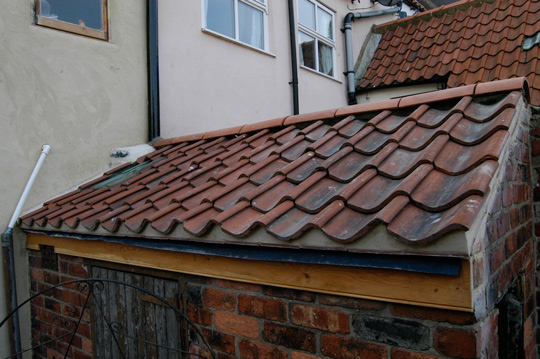
Another one ticked off the list, the wash-house roof is now complete (almost). Just the lead flashing and last few tiles to fix in place after the boiler flue has gone in. 

Using Pantiles is a bit different to the slate roofs I’ve done in past. Laying out the laths, accounting for the roof dimensions and grading the tiles are all important to getting a close fitting water tight roof.  I also had fun fitting in 4 glass tiles so the previously dark, damp and dingy toilet has a sky light. All the details will be covered over on the main site (after I’ve caught up on all the other write-ups). 

For Now I’m happy that the asbestos has gone and wash-house / toilet is water tight.  Now I can make progress on fitting a boiler and electrics and re-fitting the cistern so we can have a toilet that flushes without the use of a bucket.

Pantiled Washouse roof

Finaly a water tight Washouse with the new pantiled roof

Washhouse Re-Roofing

By Andy the stuff doer

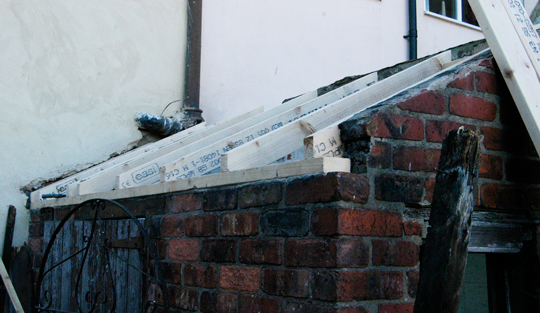
Inspired by the sight of new rendering and with a long weekend to fill it was time to make a start on the washhouse roof. We now call it a washhouse as that’s where the washing machine and boiler will be going along with the outside toilet and hand basin.  The roof I’d had patched up with sheet of hardboard last year was of Asbestos tiles on top of recycled rotten timbers, we think it may have dated from the 1930’s and replaced what is mentioned in the deeds as a conservatory.

Roof re-timbered

Wash house roof stripped and re-timbered

Kitted out with mask and disposable suit I damped down the tiles, stripped them off and bagged them up.  Then I could fully assess the state of timbers, nothing was worth saving so it all got ripped off and replaced with roughly the same size timbers so the roof height wouldn’t change too much.

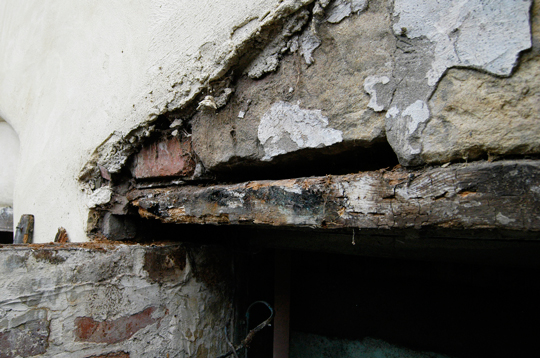
rotten timber lintel

Rotten timber lintel over the outside toilet door in desperate need of replacement

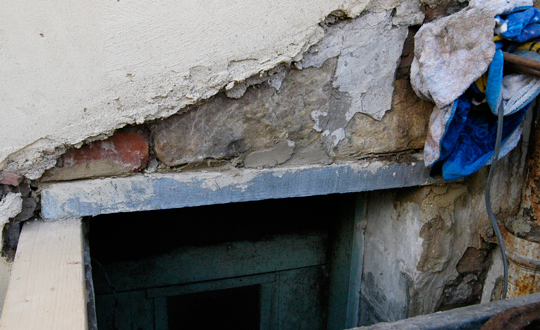
Whilst all the roof was off and I had some light to work in I also replaced the rotten timber lintel over the toilet door.  This could have been tricky if the stone and brick above had been loose but I had already deep repointed these and they were secure enough to stay in place. Never the less I still worked the old timber out gently and avoided knocking anything about until the new timber was in place. One of my scaffold boards is now three foot shorter after providing the timber but I’m happier now all of the structural rot is sorted. (Hopefully we’ll not find any more)

New timber lintel

Cut up scaffold board used as replacement timber lintel

With a breathable membrane on and the first of the slats it’s ready for tiling so then I can finish the plumbing and start thinking about a boiler.

Almost enough for one weekend, but not quite, I also managed to get the outline of the stud wall in the Attic done, to finish as a rainy day job. Followed by a few hours spent taking out the wash house window and the lead lined toilet cistern to take home so I’ve got something else to play with during the week.

Lime Render and Builders Finished

By Andy the stuff doer

It was a real relief to see the rendering of the cottage finished and the scaffolding finally down. Quite a milestone in the project and an end to having other people working on the job.  I’m not a born manager and even less comfortable paying others to do what I could do myself. It has been, however, a necessity and a decision I’m glad we took so the project can move along.

We always knew some outside help would be needed and had budgeted a certain amount for it. But as with all old places you can’t be certain of what exactly might need doing and how much it will end up costing.  The protruding gable end had to be rendered and the window arches were replaced with lintels along with the replacement lead after the theft and refitting cast iron guttering etc. the budget has stretched.

Cottage wall lime rendered

Scratch coat, base coat with hydraulic lime and sharp sand / soft sand and hair mix. Top coat with soft sand and lime with a rubbed finish.

The result is worth it, it’s all water tight and the cottage can breathe, thanks to the lime render.  The builders did a great job on interpreting my instructions for the render to “keep it soft” with rounded corners and the contours of the walls have been followed. 99% of the render looks to be perfect despite the atrocious weather they had to work around. There is a little surface cracking in some parts but nothing to worry about. I also tidied up the details around the windows with some easy scraping before the lime fully cured.

Copper Radiator – Newlyn, Arts and Crafts style

By Andy the stuff doer

We’ve only got one space in the downstairs room of the cottage that is ideal for a radiator. It’s tall and thin, because it’s tall it will be pretty much “in your face” and become a feature in the room. We searched high and low for a suitable radiator, some of the very expensive designer radiators came close but still not quite right.

OK I thought, I’m a designer and I can make stuff so why not give it a go. The only thing against it being the shortage of time but it’ll be fun so I class it at as relaxation time. All materials are from the scrap I’ve been saving up to weigh in plus a bit of left over copper pipe so apart from gas and solder it’s free and fully recycled.

I make referance to Newlyn Copper and Arts and Crafts because it’s beaten copper, the actual design though doesn’t relate to form or decoration, just the material and simalarities in the making  that give it that feel. 

copper radiator

Copper radiator with a Newlyn, Arts and Crafts feel

It’s nearly finished, with just the pipework on the back to finish off.  I’ll post the full details on the website when it’s all done in the mean while here’s the basics:

Copper Radiator design and build

Design to fit the space, transfer as much heat as possible within the build constrains and to look good / interesting in the setting.

So it’s tall and thin with airflow up the back, between the two surfaces and up the front. The design influence is Captain Cook’s Endeavour sailing ship, rather fitting for Whitby.

Copper sheet from two hot water cylinders.

Copper pipe and fittings from left overs and stripping out at the cottage

Back panel beaten from the back to emboss sails and mast

Foremast 32mm and 22mm beaten pipe (narrows for perspective)

Sails with folded and soldered seams

Spacing and heat transfer between back and sails 22mm pipe squashed square

Spacers to back panel riveted and soldered

Spacers to sails soldered (tricky details will be on the main website)

Water system 4 x 10mm pipe soldered to the back (details to maximise heat transfer will be on the main site)

That’s about it, the front will be polished but then left to tarnish and develop it’s own patina.

Home Made Copper radiator details

Home Made Copper radiator showing details for effective heat transfer

Recycling Floor Boards for the Cottage Bathroom

By Andy the stuff doer

Quick update on the story so far regarding the bathroom floor.  The floor was unsupported at one side and had sagged. The wall that could have been supporting it had bowed away. Past cover ups of the continually sagging and sinking floor had been to add another layer of boards over the top. All this got stripped away, I added a new beam and joists to properly support the floor.

More on the hand hewn beam making here

How the floor was here

One of the previous floors was pine board about 10 inches wide and still in reasonable condition. I had removed these as carefully as I could but a couple of them were / did split. Having no spare pieces these needed repairing before relaying.

Ratchet Straps alternative to sash clamps / cramps

If I’d been in the workshop back home this would have been a doddle with the cramps and clamps I have there. As I was on site with limited tools, I improvised.  Ratchet Tie down straps come in handy on many occasions especially when you’re working on your own. (I used then when  fitting the beam) This time they made an excellent job of clamping the floor boards back together as the glue set.

Ratchet straps for clamping timber

Ratchet straps used to clamp timber together

 Whilst these where drying I also mortared up the groove where the even earlier floor was set in to the wall that bowed away many years ago.

Mortared groove in bowed wall

Mortared groove in bowed wall

Three Gable Ends – Cottage Mystery

By Andy the stuff doer

It is fascinating to ponder the history of the cottage, how and when it was built and altered. Here is another set of clues on the gable end at the side of the chimney stack. The angled brickwork coming to the forefront of the picture is the stack (all repointed/rebuilt details here).

The first Section of angled stonework matches the cruck frame, even to the cut away after the third course up where the purlin would have sat. 

Three Gable ends stone and brick

Three Gable heights Hints to previous incarnations of the cottage

The stone behind is a mystery, could it be facing to this gable? If so how would it have been capped or how did the thatch go? Or was it built up when a hard roof covering replaced the thatch? Or is it more to do with a previous roof line of the adjoining building? If so why the missing stone at the purlin level? The stone wall thickness changes at the ground floor ceiling height so maybe the gable was originally timber framed around another cruck? We may never know but it’s interesting enough to be worth further investigation.

The brick above the stone is what we believe to be from the time of the Georgian roof raising alterations. The brick matches the built up and rebuilt back of the house (pics. here with the rendering chipped off) but the front is mostly stone with the just the top courses added in brick.

Anyway it’s all more information to go in to the pot when I get around to drawing up what I think the cottage could have looked like at different periods.

In the meantime it has suffered quite a bit from water ingress over a long period so I set to with a selection of stone and a few buckets hydraulic lime mortar to make sure it will last. The brick will be insulated and plastered the stone will be properly pointed and probably left exposed.   


Lime mortared Gable end inside

Fixed and roughly pointed Gable end usesing hydrualic lime mortar


Lead Theft – The Ba*$#”%ds

By Andy the stuff doer

We had just got the new roof all water tight but left the scaffolding up to do the rendering around the back. BIG MISTAKE.  The first I noticed was whilst working in the Attic one evening, the gable wall should have been getting drier instead it was soaking.  So the next morning I went up the scaffolding to find the bottom section of new lead flashing gone!

I scratched my head for a while wondering what the builders could have done. Then I checked the front, yes that had gone too.  Then the blood started to boil, I realised I was a victim. Admittedly a relatively “small” crime but the feeling of powerlessness, indignation and anger can be quite overwhelming.  A few deep breaths and a bit of mental control got me back on to my more normal stoic demeanour. ( I only slipped back a few times that day).

Lead flashing stolen from the roof

Lead fladhing stolen from roof, accessed from scaffolding

 At the front they took the flashing from both sides. An easy steal from the scaffolding although brazen on a busy street.

Lead theft from the front roof

Lead theft from the both sides of roof, all they could reach from the scaffolding

With my head back under control I could formulate a plan of action to get things sorted.

  1. Ring the police
  2. Ring the builder
  3. Ring the Missus

After reporting the crime on the non emergency 101, I was pleasantly surprised when a WPC arrived within a couple an hours, took the details, a statement and started an investigation. They were taking it seriously and yes I should report even the most minor of crimes, it helps them build up a picture and could be an important link to other crimes. Although the officer thought it would be unlikely that would catch anyone she interviewed the neighbours, the builders, contacted local business and discovered a time and rough description and the criminals and their vehicle.  It was about half past seven in the evening, a man with a bundle of something heavy and red van up the road.  Unfortunately the CCTV couldn’t get the number so the investigation was closed. So no result there, but it felt much better to have had the Police look in to it, maybe the Low Life Scum will be caught and punished at some point. So a big THANKS to Whitby Police and in particular to the officer that handled the incident, I’m impressed and grateful.

The second call brought the builder out on (arriving before the police on a Saturday Morning). He measured up for new lead and came up with a plan.  He would replace the lead on the front Monday morning and get the scaffolding taken down in the afternoon.  The back he would leave until the rendering was done so he could do the same at the back.  The plan worked, we are water tight and hopefully staying that way. 

The call to Missus brought comfort as well, I did right.  

The total cost to me has been in the region of £350 all for a scrap value of around £50 grrrr. I am insured but won’t be making a claim, after the excess and possible future premium increases it’s not worth it.  It’s all sorted now, I can swallow the extra on the budget and although the time wasted is lost forever it’s behind us now.

Re- Rendering with Lime – While we’re at it!

By Andy the stuff doer

The roof is now finished!!! But while the scaffolding is up we’ve biten the bullet and asked the builders to re render the back of the cottage. The builders have now removed the cracked cement render reavealing the hodgepodge of stone and brick, all soaking wet as the old cement render wouldn’t let the wall breath. Unfortunately the stone and brickwork are in a sorry state and will have to be re rendered but this time using  lime mortar.

Colour charts are now being scoured so we can choose the colour of the final lime wash, it wont be pink. The cottage, unfortunately, didn’t throw up any more surprises. The windows look like they’ve always been in that configuration (we’ve a reprint of a Victorian postcard that had shown possible discrepancies but it’s obviously the quality of the light or print that’s the problem).


Mud mortared stone and Georgian brick wall

Some fine stone work with original mud mortar, some altered for the window and door openings. Georgian? brick in-fills and 1st floor.

There a problem though with the window openings. The arches above the windows had started to collapsed causing some of the cracks in the render. As we’re planning on keeping the openings straight, we’ve decided to put in concrete lintels. This is by far quicker than rebuilding an arch that’s then going to be in filled and time is of the essence .

Crumbling window arch

Window arch held together by the render, they couldn't be saved

 
Arch replaced with Concrete lintel

Both window arches replaced with Concrete lintels, a shame but practical

And talking of time, we’ve just been slapped with an £80 bill from the Local Authority for the scaffold being up longer than four weeks !!!

Before it’s re-rendered the Outer Doorway needed repairing. I had already machined and new piece to replace one whole side to match the old profile, and with enough spare to scarf a piece on the other side. Some oak from the woods made a new cill. 

Door frame replaced side and scarfed side

Outer door frame repaired with maching sections, one side fully replaced the other with a new piece scarfed in at the bottom and oak cill